



(Download this Feature in Adobe Acrobat PDF Format)

Challenges of Field Biology

Duration: 45min. - 1 hour
Grade: 4th - 8th

Goal:
Through a simulation activity students will discover some of the difficulties that researchers face when trying to study and count wild populations. These challenges have led to the development of remote sensing techniques.

Objective: Students will be able to…
· Identify different censusing (counting) techniques
· Discuss why censusing is necessary

Standards:
English/Language Arts: A-1, A-2, A-3, A-4, C-1, C-2, C-3, D-3, D-4
Mathematics: A-2, A-3, A-6, B-6, B-7, D-1, D-2, E-1, E-2, E-3
Science: A-14, A-15, B-2, B-3, C-1,
Geography: A-1, A-2, A-3, B-1, B-2

Materials:
· One-quart jar of kidney, pinto and navy beans (equal amounts of each)
· Counting mask made of a piece of paper with a 2"x 2" square hole cut out of it.
· Maps and charts of the Alaskan coast line

Background:
Counting the number of animals in a wild population is often nearly impossible, especially for species with large numbers and species that spend much of their time in the water. To better understand individual species and populations, scientists estimate the numbers of animals through observation. If serious declines are reported, biologists identify areas of concern and make detailed counts. The information obtained from these counts help resource managers make the appropriate decisions for species protection.

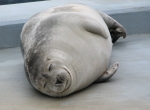
Researchers make visual observations, take photographs of a known number of animals at various densities, and practice making estimates by using computer generated exercises. Mistakes can occur when estimating populations. "Bias" often occurs because characteristics of a population may cause it to regularly be over or under represented. For example, in estimating the number of seals at or near haul out sites, the estimate would favor larger animals, hauled out of the water, with a lighter color pelage (hair or fur). Observer variability, also known as "counting error" may also cause mistakes in estimating population.


Activity:

Before the activity, set up three "haul-out sites" using the beans. Beans may be mixed to represent color variations within the population. Place these on three separate tables or desks. Each group can contain a different number of beans. Group 1 should be uniform (all pretty much in one area), Group 2 should have an area of heavy density (lots of beans together) and an area of low density (beans more widely spaced), and Group 3 should be assembled on white paper. Place a barrier in front of the beans or have students wait in another part of the room until it's time to make their counts.

Divide students into "research teams" of 5-6 people to do their estimates. Have students stand approximately 10 feet away from the beans. They should take approximately 20 seconds to estimate the number of "animals" in Group 1.

· How many beans make up the estimated total population of Group 1?
· How many of each type of bean (pinto, navy, and kidney) makes up the colony?

Biologists normally count a small group of animals and then estimate how many groups of that size make up the total group. Place a counting mask over a section of Group 1. Allow students 20 seconds to estimate the number of beans in the colony using this technique. Have the students compare these results to their first count. Try this technique on Group 2. Explain that Group 2 represents a haul-out site with two different densities of seals (perhaps a high concentration are feeding in the water and a few are hauled out on the rocks). Students may find that doing two separate counts with the counting mask to sample from both the low density and high-density areas will help them make a more accurate estimate after they average the counts.

Students should now look at Group 3. What effect does placing white paper under the beans have? (It is now easier to see the kidney and pinto beans, but difficult to see the white navy beans.) How does this relate to looking at seals in the wild? (Dark colored seals may rest on dark rocks.)
· What problems could occur when making estimates? How does bias affect a count? Example: We may over estimate the species that are easy to see, but may under estimate species that are difficult to see.
· What are some of the difficulties in counting a population? Why do biologists want to count populations? What are other ways that scientists can track animals in the wild?

Extension activities:
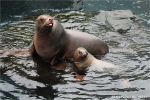
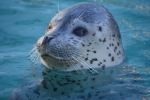
Generally, pinnipeds like seals and sea lions are counted at haul-out sites and rookeries. Aerial surveys, boat surveys and remote sensor surveys are all methods employed in observing these animals.

1. Using charts, maps, Internet and other resources, list some of the marine animals that live in Alaskan waters and whose populations are counted or "censused." Identify these animals, locate where they are found on the charts / maps and present this information to the class. Describe some of the difficulties associated with observing these animals and subsequently managing their populations.
2. Research the cost of counting wild populations of animals. Include transportation, salary, equipment, etc. Write a proposal for a research project to observe a certain population on marine animals. Include maps / charts of the area that your are proposing to do your observations.
3. What impact can scientists have on animals in the field when they are making observations? What methods may be used to avoid these problems? Write an essay describing these impacts and suggest ways to avoid them.

Challenges of Field Biology
Worksheet

Group 1 - consistent distribution # pinto beans # navy beans # kidney beans Estimated total
Estimate 1Stand approximately 10 feet from the "population" and count for 20 seconds.
Estimate 2 Place the "counting mask" over a section of Group 1. Count for 20 seconds. Trial A
Trial B
Avg. (A+B)¸2


Group 2 - varying density # pinto beans # navy beans # kidney beans Estimated total
Estimate 1Stand approximately 10 feet from the "population" and count for 20 seconds.
Estimate 2 Place the "counting mask" over a section of Group 2. Count for 20 seconds. Trial A
Trial B
Avg.(A+B)¸2


Group 3 - white background # pinto beans # navy beans # kidney beans Estimated total
Estimate 1Stand approximately 10 feet from the "population" and count for 20 seconds.
Estimate 2 Place the "counting mask" over a section of Group 3. Count for 20 seconds. Trial A
Trial B
Avg.(A+B)¸2

Follow-up Questions:

Actual number of beans in Group 1? ____________
Group 2? ____________
Group 3? ____________

1. Which counting method was the most accurate?

2. What problems could occur when making estimates?

3. What are some of the difficulties in counting a population?

4. Why do biologists want to count animal populations?

5. What are other ways that scientists can track animals in the wild?


HOME : ABOUT SATELLITE TELEMETRY: :ANIMAL TRACKING DATA: :CLASSROOM FEATURES:
:ANIMAL FACT SHEETS: :VIDEO DOWNLOADS: :ASK A MASTER SCIENTIST: :SITE FEEDBACK: