




Subsistence in Alaska

In Alaska, all residents may qualify for subsistence under the dual state-federal management system as long as the wild resource is used for food, clothing, fuel, transportation, construction, art, crafts, sharing, or customary trade. Although all Alaskans are eligible, when and where they hunt and fish is strictly regulated. According to the Alaska Department of Fish and Game (ADF&G) in 1999, approximately 60% of Alaska subsistence harvest by weight was fish, 20% land mammals, 14% marine mammals, 2% birds, 2% shellfish, and 2% plants.

Under the federal Marine Mammal Protection Act (MMPA), only Alaska natives are permitted to hunt marine mammals. Seals, sea lions, walrus, beluga and bowhead whales comprise the marine mammal harvest. This practice must be done in a non-wasteful manner. Federal agencies may restrict Native subsistence use of marine mammals only if the population of a particular species is depleted. In order to aid in recovery Alaska Native hunters may volunteer to reduce their catch.

Is there a relationship between marine mammal research and subsistence? Yes! The study of marine mammals in the wild is inherently difficult. The collection and examination of tissues from these animals is complicated by federal protective measures and permitting procedures. It is undesirable and often illegal for researchers today to sacrifice animals for research. Beached carcasses do not always provide good samples due to condition of the bodies and decomposition. What is the best way to collect marine mammal samples? Since Alaska natives are permitted to hunt marine mammals, it makes sense that partnerships between native organizations and federal agencies have been made across the state to better everyone's understanding of these animals and the environment. Section 119 of the MMPA contains provisions for the development of co-management agreements between Alaska native organizations and federal agencies for the purpose of collecting and analyzing data on marine mammal populations, monitoring subsistence harvest of marine mammals, and participating in research. Coastal Alaska native communities have relied on the marine resources for generations. Federal agencies such as the National Marine Fisheries Service (NMFS) have recognized the importance of this type of relationship.

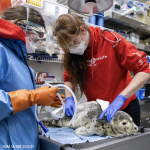
In one example, the Alaska Native Harbor Seal Commission (ANHSC) trains seal hunters and students to collect samples during seasonal hunts. These seal hunters and students represent various communities such as the Aleutians, Bristol Bay, Kodiak and Prince William Sound. In some of these areas seal populations are stable and considered healthy, in others there is great decline. The goal of this program is to compare seals from "healthy" areas to seals from areas of decline, and to involve subsistence hunters in the sampling process.

The Alaska Sea Otter & Steller Sea Lion Commission (TASSC) works in partnership with the U.S. Fish & Wildlife Service (USFWS) to manage sea otter populations in Alaska. They established a bio-sampling program to train local residents in the protocol of collecting sea otter tissue samples to be used for research. Trained bio-samplers perform necropsies, winter mortality surveys are conducted and small boat surveys are done to actively document the distribution and abundance of sea otters, Steller sea lions, and other marine mammal populations.

When native organizations such as ANHSC and TASSC work in conjunction with federal agencies, such as NMFS, the "co-management" promotes Alaska natives' participation in resource management. This partnership provides protocols to collect tissue samples for scientific research, so scientists can more efficiently assess the health and condition of marine mammals in Alaska.

When studying seals, sea otters or sea lions, various samples are collected. Tissues collected from marine mammals for study include:
· Stomachs - study diets
· Teeth - determining age
· Whiskers - stable isotope analysis (can help trace what the animal has eaten)
· Brain - stable isotope analysis
· Blubber - fat quality, fatty acid (metabolism)
· Skin & muscle - genetics analysis
· Reproductive tract - reproductive history
· Skulls - morphometric examination
· Heart

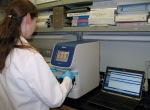
Tissue samples are sent to the University of Alaska Fairbanks and placed in the Permanent Tissue Archival Program, where they are stored and made available to researchers.

Those people who survive through subsistence traditionally develop a certain respect for the environment. In the case of Alaska natives, they obey state and federal laws as well as customary laws from their forefathers. Subsistence is a highly valued practice in rural Alaskan culture. Today, these traditional values and skills are being used to help the scientific community learn more about and preserve the marine ecosystem of Alaska.

For more information on subsistence in Alaska contact:
Alaska Department of Fish & Game
Division of Subsistence
1255 W. 8th St.
PO Box 25526
Juneau, AK 99802-4426

Web Site

HOME : ABOUT SATELLITE TELEMETRY: :ANIMAL TRACKING DATA: :CLASSROOM FEATURES:
:ANIMAL FACT SHEETS: :VIDEO DOWNLOADS: :ASK A MASTER SCIENTIST: :SITE FEEDBACK: