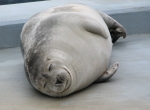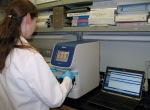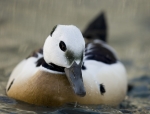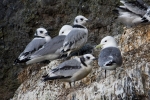



Researchers and rehabilitation staff at the Alaska SeaLife
Center (ASLC) are interested in learning more about marine
mammals, sea birds and fish. In an effort to make knowledgeable
management decisions regarding the oceans, we need to increase
our knowledge of the organisms that live in this environment.
Animals are sometimes collected from the wild and then studied
at a research facility such as ASLC, but researchers can
only learn so much from observing an animal in captivity.
Sometimes researchers will go into the "field"
to try and observe the animals in a natural habitat. But
in the case of marine mammals, seabirds and fish, the ocean
is a big place that is cold, deep and difficult to observe.
So what do you do?
Satellite telemetry tags
are used to track many different types of animals, including
marine mammals and seabirds. By using satellite tags, we
can learn important information such as habitat use and
range of movement. Data might include information on a seal's
longest recorded dive, the average dive time, and depth
of the dive. How far away from shore will the seal swim?
Where might they be finding food? Temperature and distance
can also be measured. Satellite transmitters are attached
to the animals with glue, a harness, or surgical implantation.
The Technology
A
satellite transmitter is a small electronic device that
is designed to locate and track an animal. It sends data
about an animal's environment to an ARGOS Data Collection
System. Where is this system located? On a NOAA (National
Oceanic and Atmospheric Administration) weather satellite.
The ARGOS section of the satellite receives and stores uplinked
data. This information will be downloaded later, once the
satellite passes over a ground station. The downlinked data
received by the ground station is sent to individuals with
accounts who can go onto the Internet and retrieve data
directly.
As the satellites move
through space they will pass over areas where tagged animals
are located. The location of the animal in relation to the
satellite track affects how many times in a 24-hour period
that the satellite is able to receive a transmission. Each
pass of a satellite may last between 2 and 12 minutes, depending
on the location of the satellite in relation to the animal.
In order to have a successful transmission, the animal must
be at the surface of the water at the same time the satellite
is passing overhead. So each day there are limited opportunities
for a signal to be transmitted.
In order to determine a
"fix" or position of a tagged animal the salellite
must receive two or more transmissions from the satellite
tags. If the satellite receives at least two signals during
one pass, computers at earth stations can calculate a location.
Unfortunately this is not very accurate. If a satellite
receives three or more signals it can give the location
of a tagged animal within one kilometer.
Battery life of a satellite
tag determines the amount and quality of the data. Battery
life varies depending on the size, temperature, depth, pressure,
corrosion by salt water, and number of transmissions. Transmitters
are programmed to turn on and off to conserve battery life.
For example, satellite tags will only transmit while exposed
to air, which makes them appropriate for studying marine
mammals that must surface to breathe.
What can we learn from this data?
How does this apply to your classroom?
As you navigate through this site you will
find activities that have been designed to introduce your
students to research involving marine animals and satellite
telemetry. Activities are divided based on grade levels.
Simply click on the button that your class falls under.
Activities may be done in conjunction with a visit to the
Alaska SeaLife Center or as a Marine Animal / Technology
unit in your classroom. Once you have had an opportunity
to use these activities in your classroom, please fill in
the evaluation form
and let us know what you think of Project MASTER. Teachers
submitting evaluation forms will be entered into a semi-annual
drawing for free general admission for up to 25 students,
or a classroom resource packet.