



(Download this Feature in Adobe Acrobat PDF Format)

Where in Alaska?
Using art to illustrate marine life along the coast

Grade: 3rd - 5th

Goal:
Students will be able to discuss the characteristics of a mammal and the physical adaptations of marine mammals. They will also be able to identify and discuss anatomy and morphology of different pinnipeds. Emphasis will be placed on basic art technique to produce good visual representation of the pinniped.

Objective: Students will be able to…

Identify the characteristics of a mammal and the physical adaptations of marine mammals.
· Investigate the basic physical adaptations of pinnipeds and demonstrate their knowledge of the geography of Alaska through hands-on craft activities.
· Read and create a map of coastal Alaska to locate various habitats that seals and other marine animals utilize.

Standards:
Geography - A-1, A-3, B-1, B-2, C-3
Arts - A-3, D-6

Materials:
· Bake-able clay. This may be purchased at a craft store or ordered on line at www.clayfactoryinc.com.
· Map illustrating the coastline of Alaska
· Overhead projector
· Reference books on North Pacific marine animals
· Hot glue gun for attaching animals to maps
· Scissors, crayons, glue, etc.

Activity 1:
Before students begin to create their clay seals, discuss the characteristics of mammals and marine mammals.
Mammals:

1. breathe air
2. give birth to live young
3. mammary glands to nurse young
4. have hair or fur
5. have a backbone
6. warm blooded
Marine Mammals: possess all of the above characteristics as well as…
1. often have blubber
2. hydrodynamic shape
3. tolerate tremendous pressure at depth
4. kidneys are specialized for dealing with the absence of fresh water.
5. efficient use of oxygen (higher blood volume with increased myoglobin in the muscle tissue).

The following information should be discussed with students while creating their clay seals. As you follow directions on creating your seals, go over the various body parts and their functions.

Body shape - for seals, the rounded, torpedo-shaped body design is hydrodynamic which makes them less resistant in the water. This body plan also allows the seals to slide rapidly on the ice in order to escape potential predators.

Vibrissae - "whiskers" in pinnipeds are very well developed and very sensitive. They are used for tactile purposes (to feel objects), and they are also used to detect vibrations in the water.

Front flippers - used mostly for steering while in the water and pulling their bodies along while on land. They have nails to help move around on the rocks and ice as well as for defense. They also use their front flippers to scratch. Each flipper has five digits just like human hands.

Rear flippers - used for propelling through the water. They use a lateral thunniform motion where one flipper will close while the other sweeps through the water in a back and forth motion. They also have nails on the rear flippers, but they are not known to suit any purpose. Each flipper has five digits just like human feet.

Blubber -a thick layer of blubber underneath their skin which helps them keep warm. A seal's body temperature is about one degree warmer than ours. Blubber also helps to keep them floating on the surface when they are resting. At the ASLC, researchers study blubber because pollutants tend to collect there and blubber thickness can indicate the health of the animal.

Four main functions of blubber:
· Insulation
· Food storage
· Hydrodynamic shape
· Buoyancy

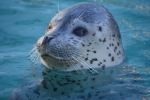
Eyes / Ears - eyes are large and highly sensitive to allow the animal to peer through the murk of coastal waters. Ears of a seal are internal and all that is observable are little holes on either side of its head. This helps to reduce water resistance and also helps to conserve heat.


1. Roll your clay into a round, smooth ball.

2. Taper one end. This end will be the head end.

3. Make the other end pointed. This end will be the tail end.

4. Bend the neck up.

5. Bend the head down.

6. Using your paper as a knife, split the tail into two pieces.

7. Push the flippers down flat and split the mouth open.

8. Pinch out two front flippers and bend the nose up.

9. Make a small, round nose and two eyes. Add other details.

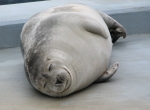
Congratulations, you have just created a clay harbor seal.

Did you notice how your seal does not have any ears? The ears of a harbor seal are internal and all that is observable are little holes on either side of its head. This helps to reduce water resistance and also helps to conserve heat.

Is your seal's body short and fat? Harbor seals have a thick layer of blubber underneath their skin, which helps to keep them warm. The water at the Alaska SeaLife Center is kept at approximately 45-50 degree Fahrenheit (about the same as our Discovery Touch Tank). Incredibly, a seal's body temperature is about 1 degree warmer than ours is! This layer of blubber also helps to keep them floating on the surface when they are resting.

If you wish to make the flippers more realistic looknig then be sure to divide them into five little sections. Just as we humans have five digits on each hand and foot, so do seals. You can also add little nails to the front flippers. These nails are mainly used for climbing out onto the icy shores, tearing fish and scratching.

Did your seal look different from the others in teh room? There are many different types of seals. Some examples are; elephant, harp, ribbon, ringed, Hawaiian monk, and bearded seals.

Bake your seal at 275 degrees for 20 minutes in a pre-heated oven. We use "Sculpty" polimer product by Polyform.


Activity 2:

Reproduce a map of the Alaskan coastline and create a transparency of the map. Use an overhead projector to draw an enlarged version for a bulletin board or classroom wall.

Students will label the map (cities, villages, Gulf of Alaska, islands, etc.). Once the map is labeled students can research the different types of marine animals that are found in Alaska. Have students draw and color pictures of the different animals and attach them to the appropriate part of the map.

Extension activities:
· Identify and compare the characteristics of the coastline that would attract a seal as a "haul-out" location. List the characteristics.
· What type of area do these animals prefer?
· Describe the diversity /variation of the coastline.
· Are there people anywhere near these environments? How close are they? What is the size of the population? Graph this information.
· List geographic areas.
· Have students' research and include other marine species, including polar bears, sea otters, sea birds like puffins or guillemots, etc.


HOME : ABOUT SATELLITE TELEMETRY: :ANIMAL TRACKING DATA: :CLASSROOM FEATURES:
:ANIMAL FACT SHEETS: :VIDEO DOWNLOADS: :ASK A MASTER SCIENTIST: :SITE FEEDBACK: